
Battery trays
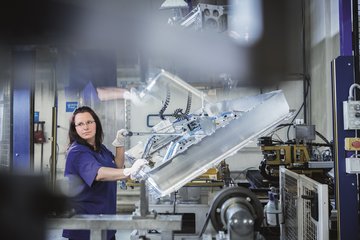
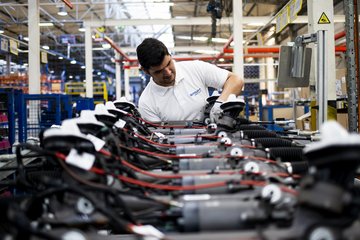
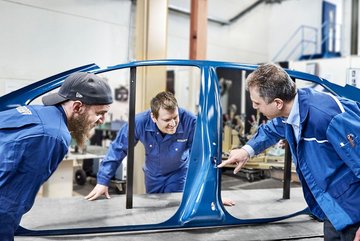
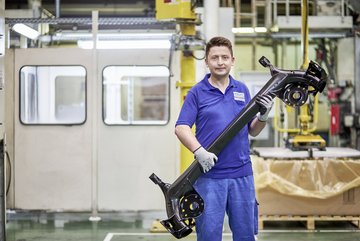
For more than a decade, BENTELER has been developing and manufacturing battery packs for renowned customers in the automotive industry.
Innovative solutions for changing requirements
Innovative solutions for changing requirements
We’re never satisfied with the status quo. That’s why, at BENTELER, we continuously invest in expanding our own expertise and are actively involved in research and early-stage development projects.
Why does BENTELER invest
in research and early-stage development?
Because we want to understand today the challenges our customers will face tomorrow. This enables us to develop optimal solutions and identify ways to adapt battery trays to changing requirements.
DID YOU KNOW…
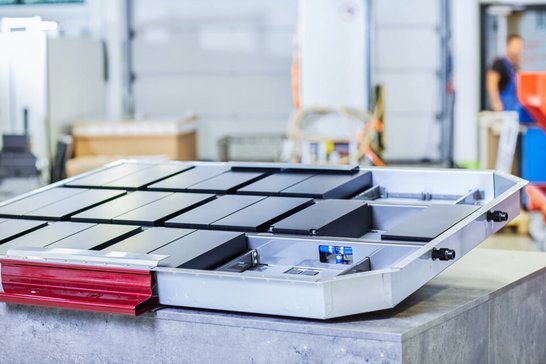
Battery trays are key components of electric vehicles. They must meet complex requirements, including mechanical loads, optimal use of installation space, thermal management, sealing, and crash safety. Battery trays must protect vehicle occupants from potential hazards posed by the battery – especially In the event of an accident.
BENTELER has many years of experience in the development and production of battery trays. As early as 2014, the first battery tray for the all-electric BMW i3 was produced at the BENTELER plant in Jablonec, Czech Republic. This was followed shortly afterward by production of the battery storage system for the Renault Zoe at our plants in France.
Battery trays

Research Projects
Concept Development for a Steel Battery Housing with Particular Consideration of Joining Technology and Corrosion Protection
Concept Development for a Steel Battery Housing with Particular Consideration of Joining Technology and Corrosion Protection
How can ultra-high-strength steels be used for modern battery housings? This question was addressed by a collaborative research project with industry participation. The aim was to harness the advantages of ultra-high-strength steels in the development of battery housings while specifically addressing limitations in terms of design freedom.
The project focused in particular on requirements relating to corrosion protection, sealing, and joining technology. A complete life cycle assessment was also carried out to comprehensively evaluate the environmental impact of the steel battery housing compared with a reference model.
The research project was funded by the German Federal Ministry for Economic Affairs and Climate Action (BMWK) as part of the Industrial Collective Research (IGF) initiative “Key Technologies for the Energy Transition” and was coordinated by the Research Association for Steel Application (FOSTA). The Research Association of Automotive Technology (FAT) and the Research Association for Pigments and Coatings (FPL) supported the project as cooperating research associations.
The project was completed successfully.
ULSAS E-VAN: Ultra-Lightweight Body Structure for a Light Electric Commercial Vehicle
How can lightweight design, cost-effectiveness, and electric mobility be combined in light commercial vehicles? This was the focus of the ULSAS E-VAN research project.
BENTELER, together with its partners Ford-Werke GmbH, Altair Engineering GmbH, Franken Guss GmbH + Co. KG, C-TEC GmbH, MORPHOTEC, voxeljet AG, and RWTH Aachen University (IKA & SLA) developed lightweight body structures and a modular battery tray system for electrically powered light commercial vehicles.
The focus was on cost-effective lightweight design for a particularly cost-sensitive market segment. For the body structure, the frame-and-stringer construction method familiar from aircraft engineering was developed for high-volume automotive applications. BENTELER focused on developing a modular, size-scalable battery tray system.
The research project was funded by the German Federal Ministry for Economic Affairs and Climate Action (BMWK) as part of the “Lightweight Construction” Technology Transfer Program.
The project was completed successfully. Further information and project results are available via EnArgus.
Concept Development for a Circular-Economy-Based, Steel-Intensive Modular Construction Approach for Electrically Powered Vehicles (KoZiMo)
KoZiMo investigates the potential of steel-intensive, circular-economy based modular vehicle designs for electrically powered vehicles. The aim of the project is to develop new vehicle concepts that combine sustainability, resource efficiency, and technical performance.
The project focuses on:
- Modular designs for electrically powered vehicles
- Structural simulation and virtual validation of vehicle concepts
- Disassembly and repairability of vehicle structures
- Sustainability assessments and life cycle analyses
- Joining technologies for modular vehicle concepts
- The use of steel and ultra-high-strength steels for future-ready vehicle structures
The project contributes to the development of sustainable and cost-effective vehicle concepts for electric mobility and investigates how modular steel designs can support a circular economy in automotive manufacturing.
Further information is available on the RWTH Aachen University website.